

How to choose an office chair for your height and desk
Height is only a starting point. Seat height, usable depth, armrest position and clearance below the desk determine whether a chair fits your workspace.
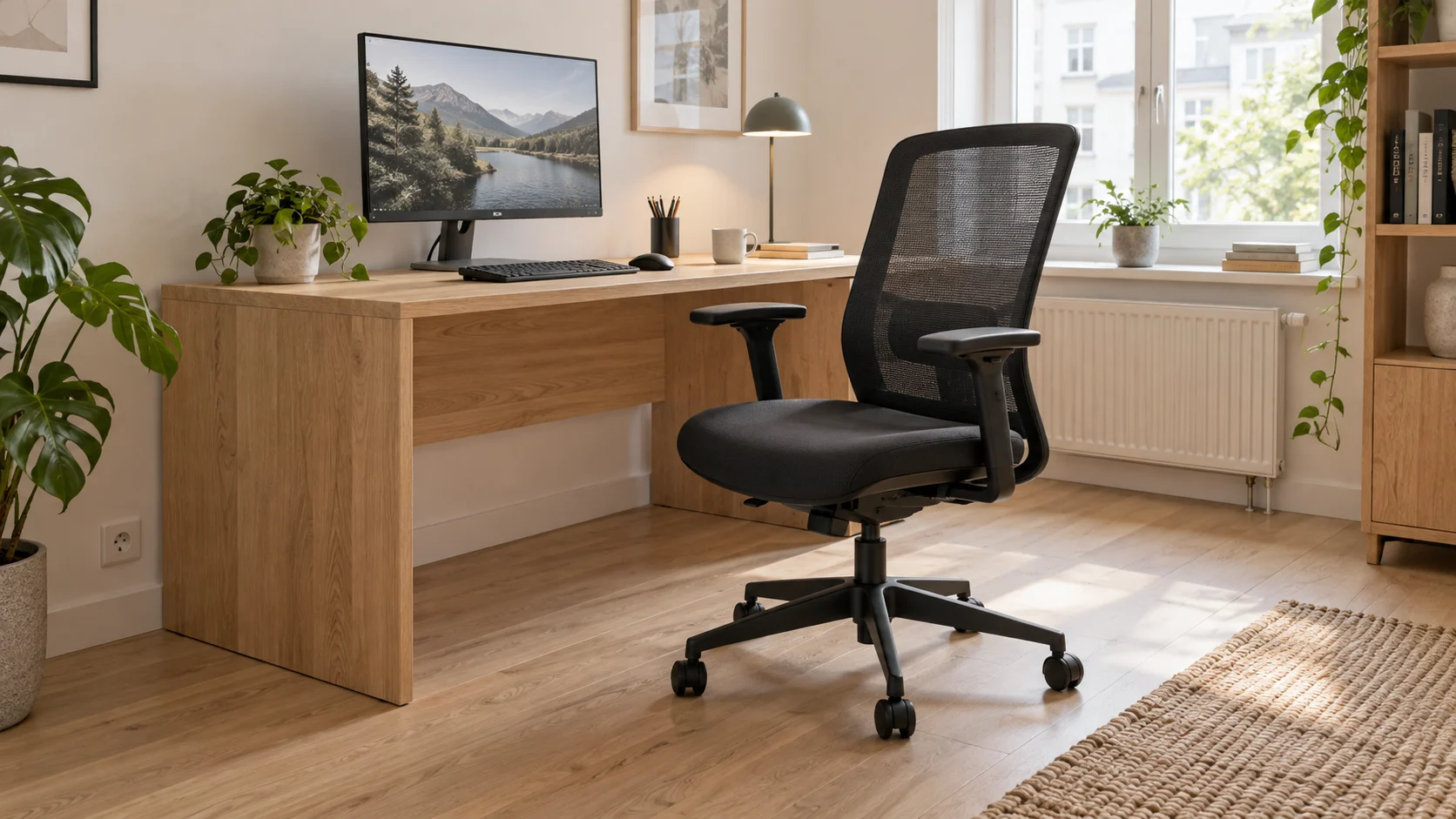
Choose an office chair by fit and adjustment range, rather than body height or the word “ergonomic” alone. Check foot support, seat depth and access to the desk first; then compare the backrest, armrests, load limit and casters. Browse the office chairs category for individual specifications. This guide explains the checks and compares four different options from Bonideco.
Choosing seat height and depth for your body
Two people of the same height can have different leg lengths and proportions. A universal height-to-chair chart cannot replace a fit check. Look specifically for seat height from the floor: overall height including the headrest does not show how low the seat goes.
When trying a chair, support your feet on the floor or a stable footrest. Sit back without the seat edge pressing behind your knees. Check usable width between the armrests rather than the outside body width. Footwear and cushion compression also affect the final sitting position.
If a trial suggests that a seat height around 43 cm suits you, a 40–50 cm range includes it and a 49–59 cm range does not. This illustrates how to compare ranges, not a recommended setting for a particular body height. Ask how the manufacturer measures the seat and try the chair when possible.
Seat depth and depth adjustment are different specifications. A 50 cm long seat does not necessarily slide forwards and backwards. If you cannot reach the backrest without pressure behind your knees, check a shallower usable seat or a sliding-seat model. Taller users also need adequate thigh support.
Matching an office chair to your desk
Measure the work surface and clear height underneath it, including the apron, drawers and cable tray. For example, a tabletop at 75 cm with a 7 cm apron leaves an obstruction at 68 cm. An armrest at 70 cm will not pass beneath it. This is a separate measuring example, not a specification for every desk.
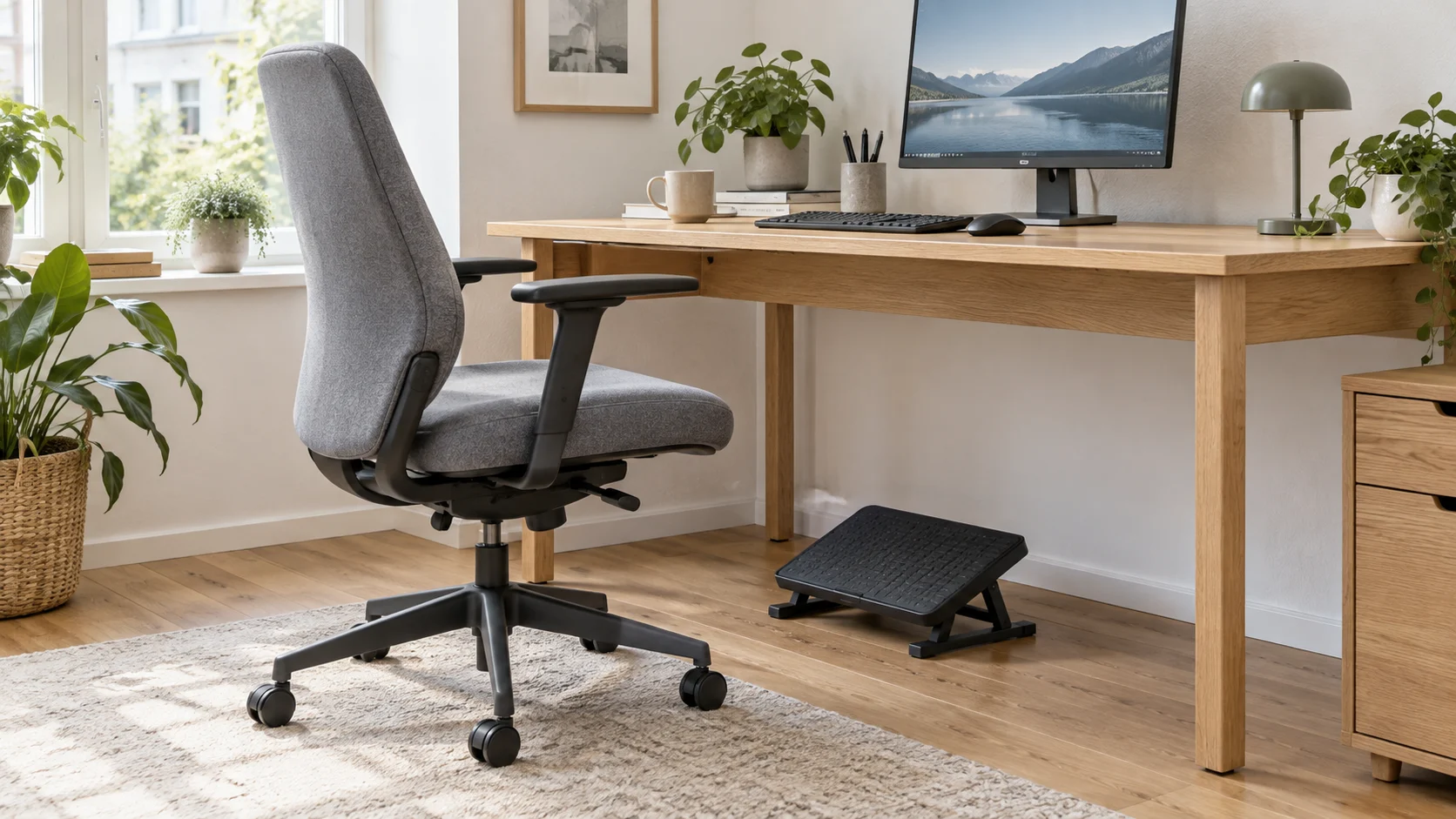
Check access to the keyboard and mouse without raised shoulders or outstretched arms. If a high desk requires raising the chair, a stable footrest or a change in work surface height may be needed. Do not sacrifice foot support merely to tuck the chair underneath.
Flip-up armrests can help store the chair, but flipping up is different from adjusting support height while working. Separate armrest height and position adjustments can be useful for shared chairs. Check what 2D, 3D or 4D means in the specific description; the supported movements vary.
Allow space to swivel, roll back and stand up. Check drawers, a pedestal and the passage behind the chair. Our desk buying guide helps coordinate the workstation, while the small room planning guide covers arranging a limited space.
Backrest, mechanism, upholstery and casters: what to check
Check the position and available adjustments of lumbar support; a headrest should not force your head forwards. Having these parts alone does not establish comfort. If a chair is described as ergonomic, look for concrete adjustment specifications rather than a promise of identical fit for everyone.
A rocking mechanism is not necessarily a synchronous mechanism. Ask whether only the backrest tilts or the seat moves too, and check locking positions and resistance adjustment. Maximum recline does not describe typing comfort. An extendable leg rest does not automatically replace foot support in the working position.
Mesh and fabric differ in surface feel and care. A mesh back does not mean a mesh seat, and soft upholstery does not establish suitable support. Check composition, cleaning requirements, replaceable parts and caster suitability for your flooring. Even PU casters do not guarantee mark-free use on every floor.
Compare the stated load limit and its conditions. Maximum static load is not a promise covering every use. Follow assembly and recline instructions and check replacement caster availability. Change position and take breaks during work: chair adjustments do not replace movement.
Four office chairs: documented features and limitations
This comparison uses Bonideco descriptions, not hands-on testing. Heights below refer to the seat above the floor, not overall chair height. Check current prices, delivery and availability in the standard product cards.
| Model | Seat height | Stated load limit | Documented features | What to confirm |
|---|---|---|---|---|
| 921-846V00BK | 40–50 cm | 120 kg maximum | Mesh upholstery, flip-up armrests, swivel and casters. | Usable seat depth and width; flip-up does not establish armrest height adjustment. |
| SONGMICS OBN066BH01 | 49–59 cm | 150 kg maximum static | Adjustable lumbar support and headrest; armrests 73–88 cm above the floor. | Minimum sitting height and armrest clearance under the desk apron; seat sliding is not stated. |
| 921-954V00GY | 47–55 cm | 120 kg maximum | Chenille upholstery, gentle rocking, steel base and PU casters. | Armrest adjustment and floor compatibility; seat sliding is not confirmed. |
| 921-985V01LG | Not stated in the description | 180 kg maximum | 57 cm wide seat, adjustable lumbar air cushion; height-adjustable and flip-up armrests. | Seat height range and usable depth before ordering; 114–122 cm is overall chair height. |
Scroll horizontally to compare
Seven checks before buying
- Record the seat height range you need, not overall chair height.
- Check usable depth, width and access to the backrest.
- Measure desk underside and armrest height above the floor.
- Confirm mechanism movement, locking and resistance.
- Check the load limit and manufacturer conditions.
- Check casters, upholstery, assembly and spare parts.
- Allow rolling space and passage; confirm delivery and what is included.
Common questions about office chairs
Which chair suits a shorter person?
Start with minimum seat height and usable depth. Feet need support and the backrest must remain reachable; body height alone is not enough.
Does a 150 kg chair suit every person?
No. The load limit does not determine sitting height, width between armrests or seat depth. Check the conditions behind the stated limit too.
Is mesh or fabric better?
Choose by feel, seat construction, care and room conditions. Material does not replace suitable dimensions and adjustments.
Are flip-up armrests height-adjustable?
Not necessarily. Flipping up and changing the working support height are different functions. Check the specific model description.
Do I need a sliding seat?
It can help when fixed depth does not fit or people of different heights share the chair. Check the actual travel range first.
Is there one best office chair for all-day work?
No single chair suits everyone. Match the dimensions, adjustments and workstation, try the fit where possible and change position during the day.
With your workspace measurements ready, compare Bonideco office chairs. Choose by documented specifications and clarify missing dimensions or functions before ordering.